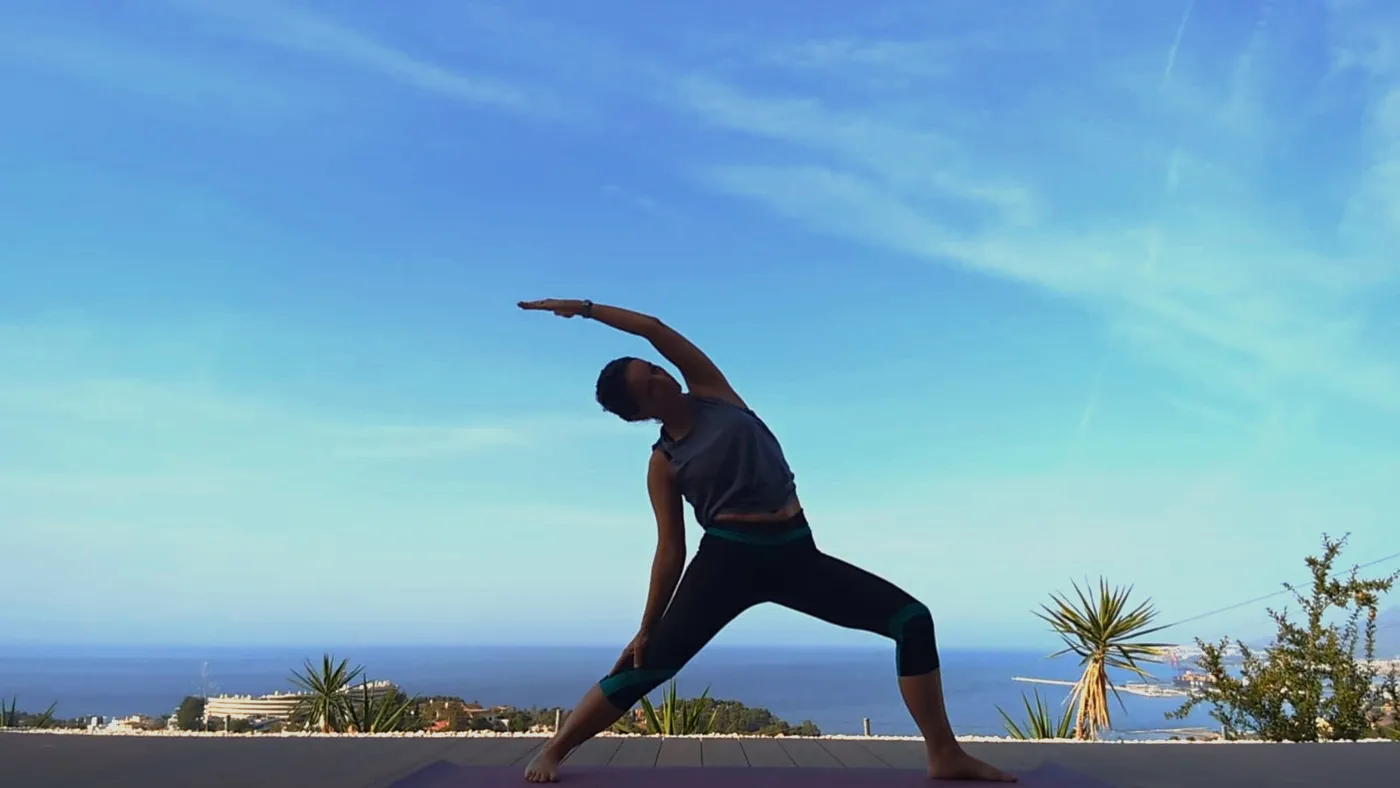
People use these two words as if they meant the same thing. They do not, and the difference explains why some people stretch for years and still feel stiff and unsteady.
Flexibility: passive range
Flexibility is how far a muscle or joint can be lengthened when something else does the work. You pull your foot towards your bottom with your hand. You sink into a split with your weight. You lie on your back and let a friend lift your leg. The range is there, but you are not producing it.
It matters. Harvard Health says "we need that flexibility to maintain a range of motion in the joints" (Harvard Health). Without enough flexibility, you have no range to work with.
Mobility: range you can control
Mobility is active range. It is how far you can move a joint using your own muscles, and whether you can stay strong and steady at the end of that range. Lifting your leg high without holding it. Squatting deep and standing back up without wobbling. Reaching overhead without arching your back.
Here is the simplest way to say it: flexibility is the range you have, mobility is the range you can use. Mobility needs flexibility, plus strength, balance and control.
A note on words: coaches and researchers do not all define these terms exactly the same way. This is the common practical meaning, and it is the one that helps you decide what to train.
A quick way to see the gap
Lie on your back and pull one straight leg towards you with both hands. Note how high it goes. Now let go and lift the same leg as high as you can on your own, keeping the other leg flat. The difference between the two heights is your gap between flexibility and mobility. The bigger the gap, the more strength and control are missing in that range.
That is one test, not a complete practice. A full session also trains your hips, spine, shoulders, legs and balance, and builds up in steps.
Why mobility matters more after 40
Daily life is active, not passive. Nobody lowers themselves onto the floor, climbs stairs or reaches a high shelf by being pulled into position. You need range you can control.
It also gets harder to ignore strength as we age. After 30, people can lose as much as 3% to 5% of their muscle mass per decade (Harvard Health). Less muscle means less control at the edges of your range, so joints feel stiff and guarded even when the tissue itself could lengthen. That is why a stretch-only routine often stops working after 40. If this sounds like your mornings, see Why Do I Feel Stiff Every Morning?
Prefer to be guided? The 7-Day Move Better Reset is 7 short video sessions, 10 to 15 minutes a day, for €9.
Try the Reset for €9Which should you train?
Both, but not in the same proportion for everyone.
- Very stiff and hard to move into positions: start with gentle range work so you have something to control.
- Flexible but wobbly, or prone to sore joints: you probably need more strength and control in your range, not more stretching.
- Somewhere in the middle, like most adults who sit a lot: train them together. I am over 40 and sit at a desk for around eight hours a day, and this is the balance I aim for in my own practice.
Why yoga trains both
Yoga is often called stretching, but a good practice is much more than that. It takes your joints through their full range, then asks you to hold and control positions with your own body weight. Holding a lunge, lowering slowly from a plank or balancing on one leg are all strength and control work, at the end of your range. The NHS lists yoga among its muscle-strengthening activities (NHS).
So one practice builds flexibility, mobility, strength and balance together, instead of treating them as separate jobs. If you want the full picture, read How to Improve Mobility After 40 with Yoga. If you are short on time, Is 10 Minutes of Movement a Day Enough? explains what short sessions can do.
When to see a doctor
See a GP if you lose movement suddenly, if a joint is swollen, hot or red, if you have numbness, tingling or sharp pain, or if stiffness keeps getting worse instead of easing with movement. Never push into a stretch through pain.
Flexibility is the range you have. Mobility is the range you can control. After 40, build the second without losing the first.