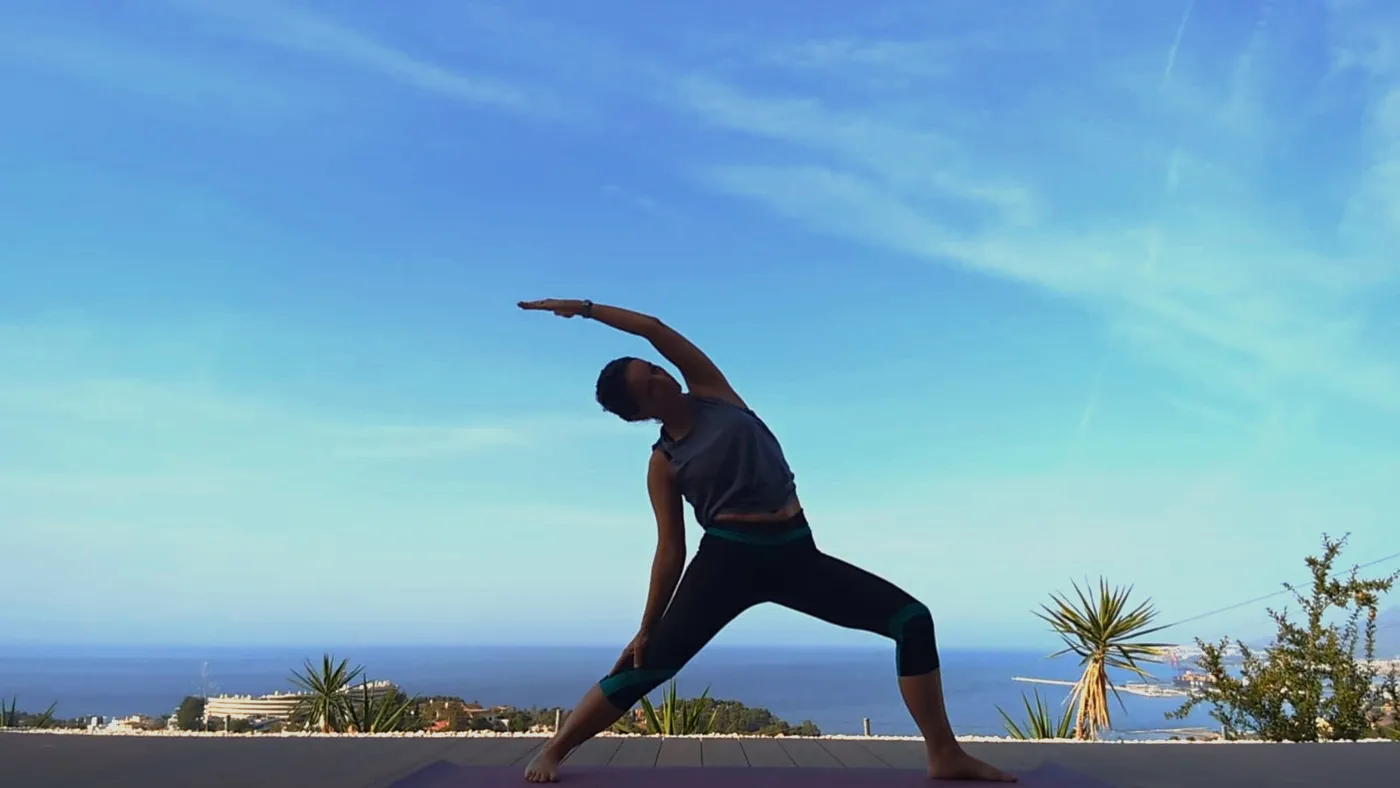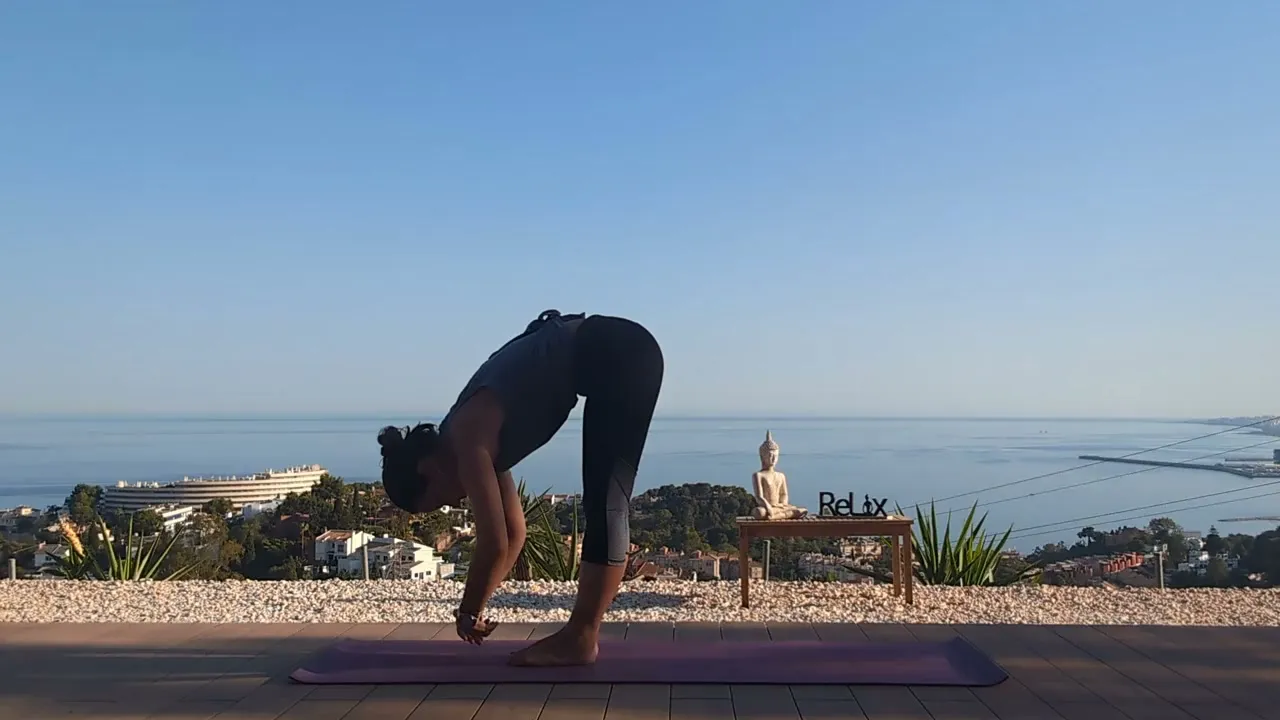
Reaching down and finding your hands stop at the knees or shins is frustrating. Many adults over 40 notice it and assume they have simply become "not flexible". I spend around eight hours a day at a desk, so I know how quickly forward folds change when life gets sedentary.
The reality is more interesting, and more hopeful, than "tight hamstrings".
The main reasons you cannot touch your toes
- Hamstrings. These muscles run down the back of the thigh and do limit the fold. But length is not the whole story, as we will see below.
- Hip hinge. A good forward fold comes mostly from the hips tipping forward, not from rounding the back. If your hips do not rotate well, the back and hamstrings take the strain and stop you early.
- Nervous system tension. Your body limits a stretch when it senses threat, long before the tissue itself is at its limit. This is called stretch tolerance.
- Sitting. Hours in a chair keep hips bent and hamstrings short and quiet. The NHS advises breaking up long periods of not moving with some activity (NHS).
- Body proportions and practice. Long arms or a short torso change what a toe touch needs, and a movement you never practise gets harder.
It is not only muscle length
A study of endurance-trained athletes grouped them as "tight" or "normal" using a toe-touch test. The tight group had lower stretch tolerance, and their hamstring muscle size and muscle activity during stretching did not differ from the other group (Magnusson et al., 1997). In other words, how far you will let yourself go matters, not only how long the muscle is.
A small study of 13 healthy adults found that a technique that gently moves the nerve along the back of the leg increased hamstring extensibility straight afterwards (Pietrzak and Vollaard, 2018). It is a small study, so treat it as a hint rather than proof. But it fits what many people feel: a pulling sensation behind the knee that is more "stretchy wire" than "short muscle".
Does it matter if you cannot touch your toes?
On its own, no. The toe touch is one movement, and plenty of healthy, active people cannot do it. What matters more is whether you can bend to pick things up, put on shoes, get down to the floor and back up, and whether that range is holding steady or shrinking.
When to see a doctor
See a GP or physiotherapist if bending forward causes sharp pain, pain that travels down the leg, numbness or tingling, or if the problem started after a fall or injury. Do not try to stretch through these symptoms.
How to improve it safely
- Do not force it. Pushing hard or bouncing makes the body guard more. A firm, comfortable stretch you can breathe through works better.
- Learn the hinge. Practise folding from the hips with a long spine, with soft knees, before worrying about how far down you get.
- Work the whole chain. Hamstrings, hips, calves and lower back all contribute, and so does strength: legs that can control the movement let the body relax into it.
- Little and often. Short sessions most days beat one long one. See Is 10 Minutes of Movement a Day Enough?
- Break up sitting. Our guide to why hips feel stiff after sitting explains why this helps.
Prefer to be guided? The 7-Day Move Better Reset is 7 short video sessions, 10 to 15 minutes a day, for €9.
Try the Reset for €9Why yoga suits this problem
Yoga is often reduced to stretching, but a good practice does much more. It moves your hips, hamstrings and spine through their range, asks you to control that range, and uses your body weight for strength in the legs, hips and back. Standing balance work trains the control and confidence that make bending forward feel safer. The NHS lists yoga among its muscle-strengthening activities (NHS).
That mix of range, joint control, strength and balance is why yoga improves more than the toe touch: it improves how you move. The bigger picture is in Yoga for Mobility After 40, and Can You Regain Flexibility After 40? looks at what to expect.
One move to try: a hinge with soft knees
Stand with feet hip-width apart and bend your knees generously. Rest your hands on your thighs, then breathe out and tip your hips back so your torso folds forward with a long spine. Let your hands slide down towards your shins only as far as feels comfortable.
It is one useful move, not a complete practice. A full practice also builds strength and balance and progresses over weeks, and pairs well with a routine you can actually keep.
Sources
- NHS physical activity guidelines for adults (yoga listed among muscle-strengthening activities; break up long periods of not moving)
- Magnusson et al. 1997, Scandinavian Journal of Medicine and Science in Sports (tight versus normal toe touch: stretch tolerance and stiffness)
- Pietrzak and Vollaard 2018, Journal of Sport Rehabilitation (neurodynamic technique and hamstring extensibility)